Drinking water against IS 10500
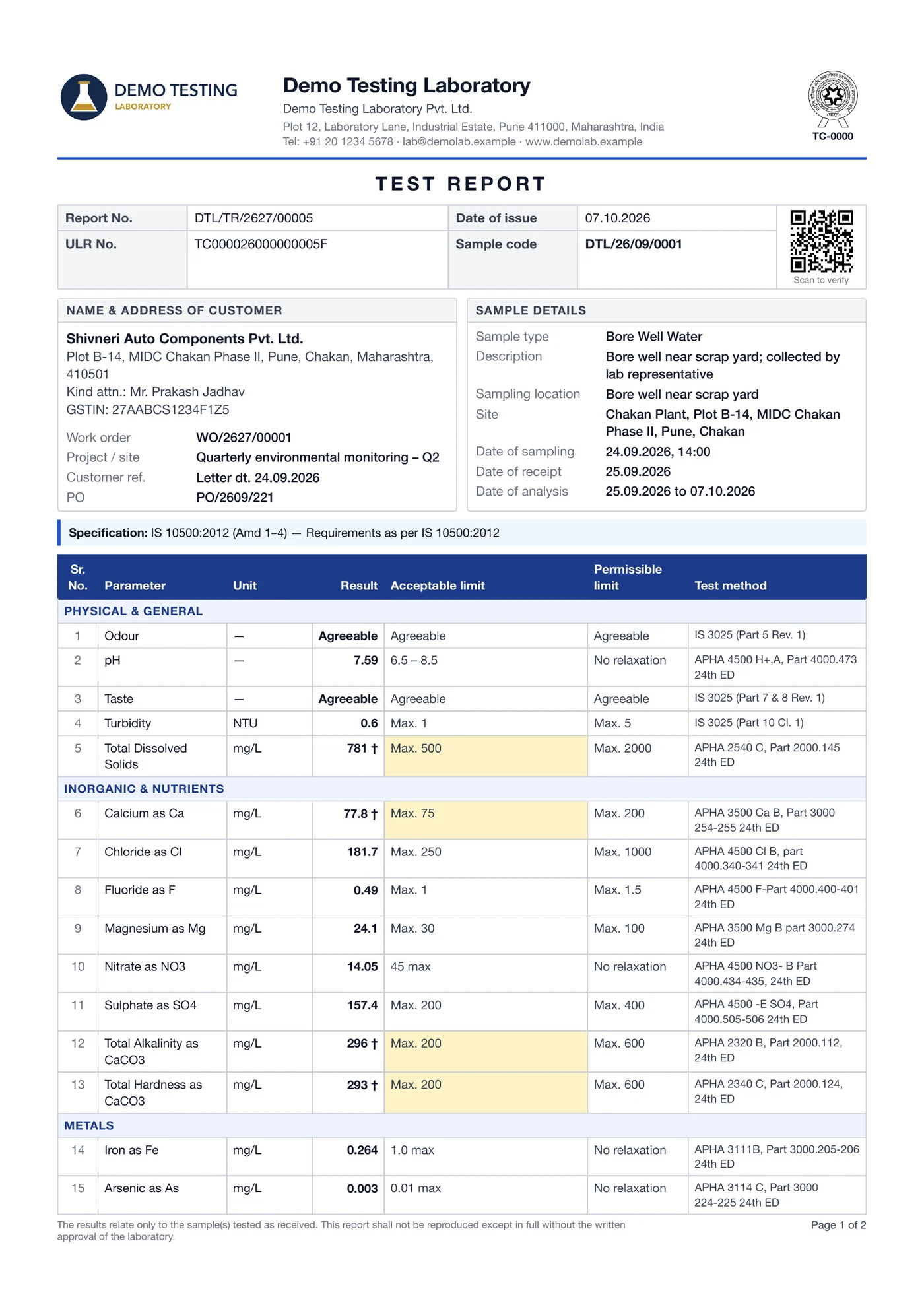
For many parameters IS 10500 sets two limits: acceptable, and permissible in the absence of an alternate source. Tanush LIMS carries both. When you register a drinking water, bore well, tap, hand pump or open well sample, IS 10500:2012 (Amd 1–4) is pre-selected as its specification, and the parameter picker adds every IS 10500 parameter in one click.
On the review screen each result sits beside its limits, for chloride “Acceptable: ≤ 250” and “Permissible: ≤ 1000”, with a Complies or Does not comply badge. A result above the acceptable limit but within the permissible limit shows as Within permissible †. It is not counted as over the limit.
On the report the acceptable and permissible limits are two columns. A † marks a result between them and a red * marks a result outside the limit, each with its footnote.
Worked example: chloride in drinking water
| Sample titres (duplicates) | 18.8 and 19.0 mL |
|---|---|
| Blank titre | 0.2 mL |
| Silver nitrate | 0.0141 N |
| Sample volume taken | 50 mL |
| Chloride as Cl | 186.9 mg/L, RPD 1.07% |
| IS 10500 (acceptable 250, permissible 1000) | Complies |
The blank and normality go in once per worksheet run, and duplicates more than 10% apart get a warning. The default chloride method for drinking water is APHA 4500 Cl B; IS 3025 (Part 32) gives the same result.
Packaged drinking water and other water standards
Packaged drinking water and natural mineral water are their own sample types, with IS 14543 and the FSSAI standards for packaged and mineral water. Also built in: IS 3328 for swimming pools, the CPCB best use and bathing water criteria for rivers and lakes, and IS 456 for construction water.
Every standard arrives as a draft. Your Technical Manager opens the ones you use, checks the limits and activates them; until then reports print no limits. Limits change only through dated versions, so a past report never changes.
Effluent under E(P) Rules Schedule VI
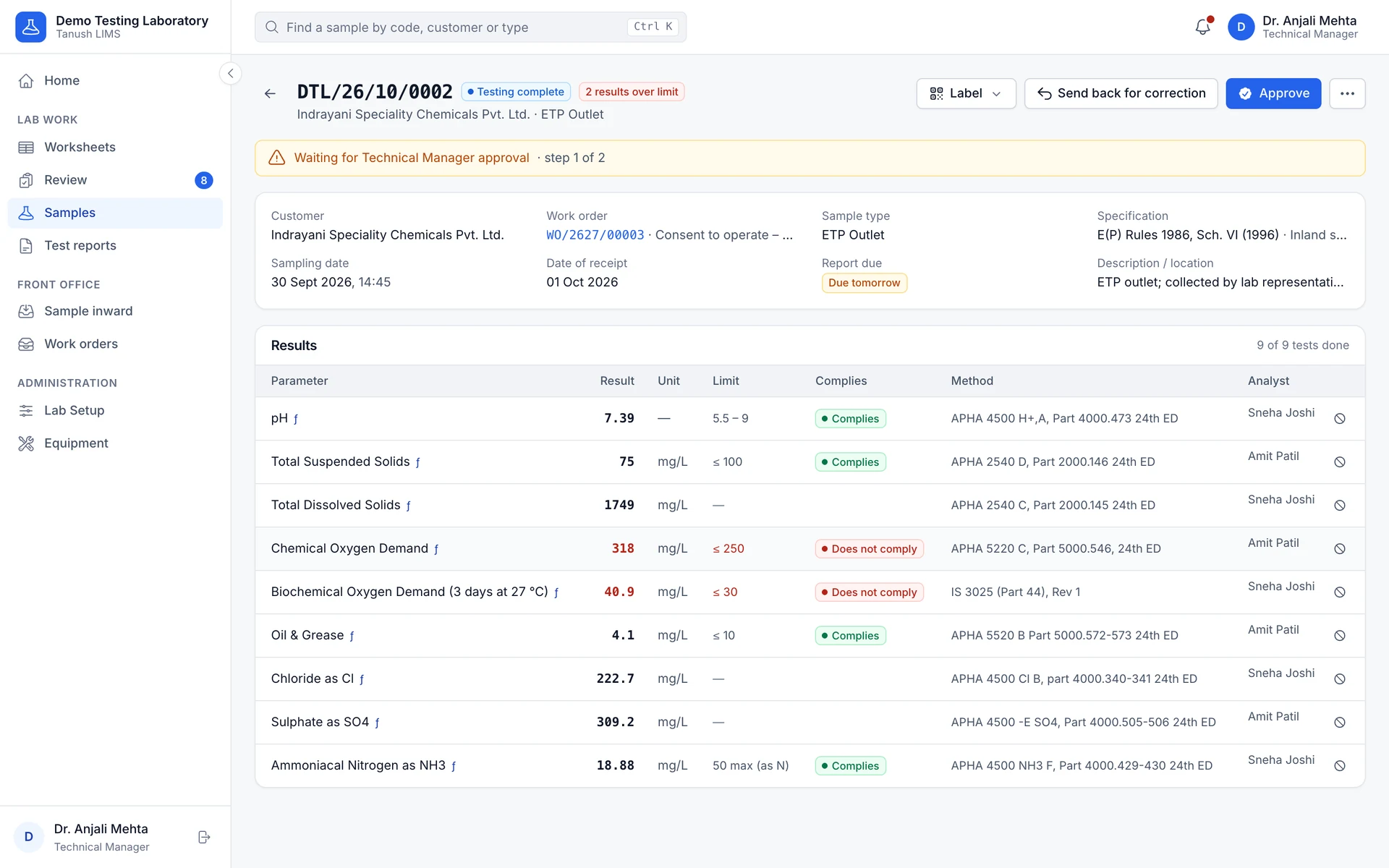
Schedule VI limits depend on where the effluent goes. For an ETP outlet sample, Tanush LIMS pre-selects E(P) Rules 1986, Sch. VI (1996) and asks Discharge to: inland surface water, public sewer, land for irrigation, marine coastal area, or not discharged (recycled, reused or zero liquid discharge, where no discharge limit applies). Inward won't save until it is answered, so no effluent sample is judged without its discharge point.
Worked example: COD in an ETP outlet
| FAS titre for blank | 24.6 mL |
|---|---|
| FAS titre for sample | 16.6 mL |
| FAS normality (standardised that day) | 0.0998 N |
| Sample volume refluxed | 20 mL |
| Chemical oxygen demand | 319 mg/L |
| Inland surface water (limit 250 mg/L) | Does not comply |
The sample page shows “1 result over limit”, the approve dialog names it again before anyone signs, and the report prints it in red with an asterisk. Had the effluent gone to a public sewer or to land for irrigation, Schedule VI sets no COD limit. FAS normality has no default: the analyst types the day's standardised strength once per worksheet.
ETP, STP and CETP monitoring
ETP and STP inlet and outlet samples, CETP samples and hospital effluent are built-in sample types, with CETP standards and the STP standards (2017 notification, NGT 2019) beside Schedule VI Part A.
- Consent limits. A customer's consent limits can be set up as their own specification, offered only for their samples.
- Sampling points. A sampling point fills in the sample type, location and specification, and “Repeat last order” copies the last work order, which suits monthly visits.
- Metals. AAS and ICP export files fill the readings on metals worksheets, with blanks and standards skipped.
- One report per project. Several samples of a monitoring project can go into one combined report.
Holding times for BOD, coliforms and other tests
About 130 of the library's 602 methods come with a holding time for your lab to confirm: for example 48 hours for BOD, nitrate and turbidity, 8 hours for DO and for coliforms in wastewater, and 30 hours for microbiological counts.
From inward on, each time-bound test shows when its analysis must start, counted from the date and time of sampling, and Home lists the tests to start first. A sample that arrives after its holding time is flagged at inward: the customer can agree to testing anyway, or those tests are cancelled. A test started late prints ‡ on the report.
If a bottle holds less than the tests need, the customer's agreement is recorded at inward and those results print ◊. For how these marks sit on an accredited report, see LIMS for NABL-accredited labs.
Further reading
- BOD and COD tests explained: methods, calculations and limitsBOD and COD test procedures under IS 3025 and APHA, with the calculations, a worked COD example, holding times and Schedule VI effluent limits.
- How to start a water testing lab in India: setup and approvalsHow to start a water testing laboratory in India: scope, layout, equipment by parameter, staff, NABL accreditation and MoEF&CC, FSSAI and BIS approvals.
- IS 10500:2012 drinking water standards: parameters and limitsIS 10500:2012 drinking water standards with every parameter, acceptable and permissible limit, test method and all four BIS amendments, in plain tables.