Ambient air against NAAQS 2009
For an ambient air sample, NAAQS 2009 is pre-selected. Its limits depend on the area and on how long the air was sampled, so inward asks for the area category (industrial, residential, rural and other, or ecologically sensitive area) and the averaging time, which starts at 24 hours. The area category has no default, and inward won't save until it is chosen.
Worked example: PM10 over 24 hours, IS 5182 (Part 23)
| Filter weight before sampling | 2512.4 mg |
|---|---|
| Filter weight after sampling | 2650.8 mg |
| Average flow rate | 1.12 m³/min |
| Sampling time | 1440 min |
| Air volume | 1612.8 m³ |
| PM10 | 86 µg/m³ |
| NAAQS 2009, 24 hours (limit 100 µg/m³) | Complies |
Filter weights are typed in milligrams, and the form says so. For colorimetric gases such as NH3, NO2, SO2 and ozone, the analyst types the run's calibration factor, or the slope and intercept, once, and every sample on the worksheet calculates from it.
Work-zone air and indoor air are sample types of their own, with the Factories Act Schedule II work environment limits, and ISHRAE IEQ and NBC 2016 indoor air quality, in the library.
Stack emission reports
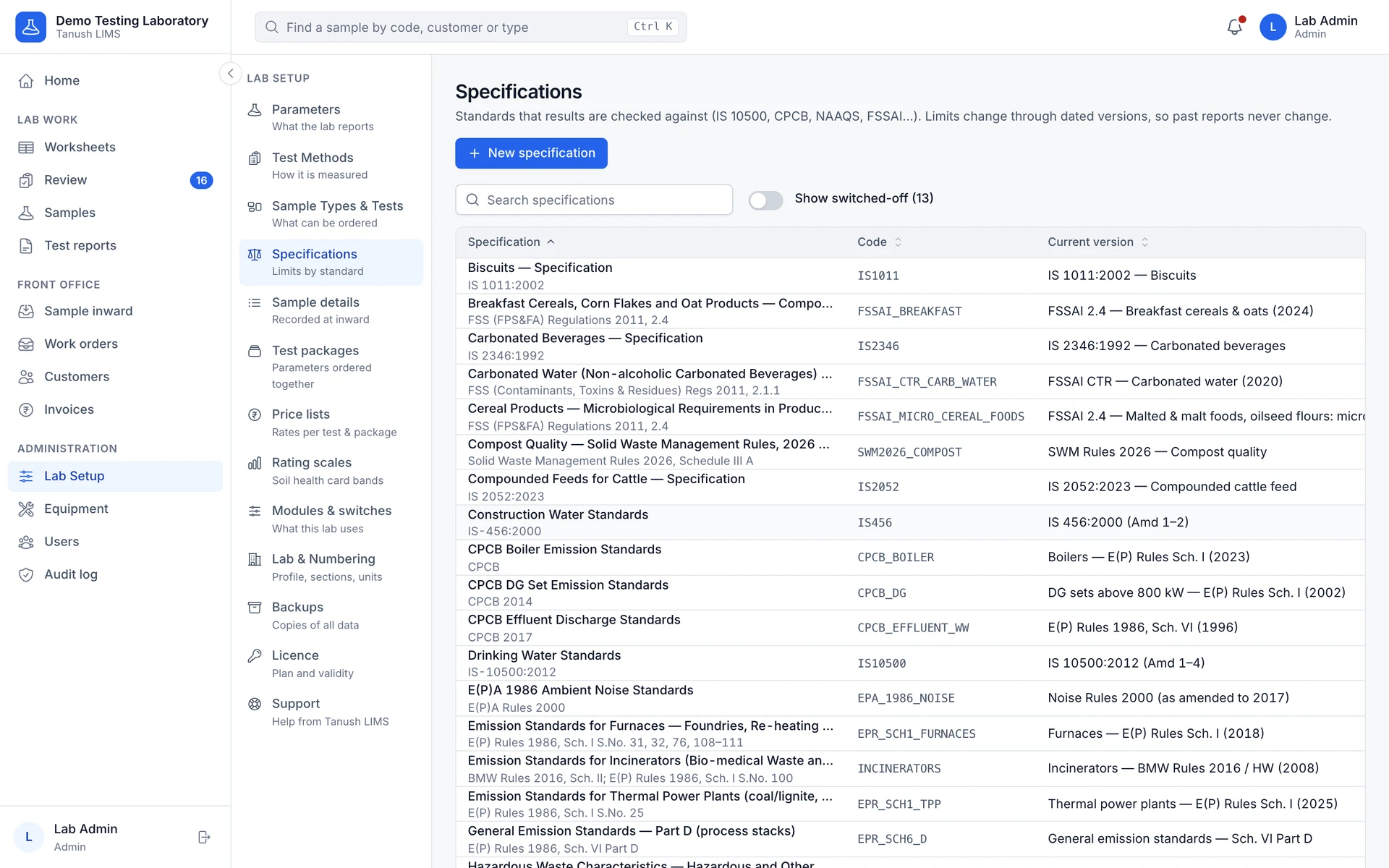
DG set, boiler, process, incinerator and furnace stacks are built-in sample types. The library holds the E(P) Rules stack standards for boilers, thermal power plants, DG sets above 800 kW, incinerators, furnaces and Part D process stacks, with limits normalised to oxygen where the standard asks for it.
Stack samples print in the stack emission layout: a Stack and flue gas details section above the results, and an Emission rate (kg/h) column beside each result.
Noise and lux
Ambient, work-zone and DG set noise are sample types, with the noise rules, DG set noise limits and factory noise exposure limits built in. The noise layout prints each location with its area category, and day time (06:00 to 22:00) and night time (22:00 to 06:00) Leq in dB(A) beside the limit for each. An annexure lists the hourly Leq values, and the test method line names who measured at site and with which instrument.
Illumination (lux) is its own group, for workplace and building lighting against the factory lighting rules and NBC 2016.
Field samplers and site readings
Field sampler is one of the six roles in Tanush LIMS, and each role sees only its own part of the work. When your own sampler draws a sample, inward records the sampler, the sampling method or plan, and the date and time of monitoring.
Readings measured at site can be entered with the sample. Anything not yet entered waits on Home under Site readings to enter, for the field sampler, front office or Technical Manager to complete.
One report for an EIA or monitoring project
A monitoring round often means many samples of one kind for one project, such as several ambient air stations. One combined report puts them in a single report, with a samples table and each parameter's results laid out sample by sample. Combined reports are on by default and can be switched off.
Each sample keeps its own sample code, results and limit check, and goes through the same review and approval as any other sample. For accredited labs, the NABL symbol and ULR follow your scope; see LIMS for NABL-accredited labs.
Further reading
- Ambient air quality monitoring in India: NAAQS 2009 and CPCBAmbient air quality monitoring guidelines from CPCB: all 12 NAAQS 2009 limits, monitoring frequency, a worked PM10 gravimetric calculation and reporting.
- Stack emission monitoring in India: CPCB methods and reportingStack emission monitoring in India: CPCB port and isokinetic sampling rules, IS 11255 methods, O2 correction, emission rate in kg/h, boiler and DG limits.