Book a demo
LIMS software for NABL testing labs in India

Readings in. Approved reports out.

A laboratory information management system for environmental, water, food, soil and air testing labs in India. Your analysts type the readings; Tanush LIMS calculates the result, checks it against the right standard and makes the report. It runs on your lab's own Windows PC, so it works without internet.

Book a 20-minute demo

Made and supported by Tanush Digital: 30+ projects shipped, 0 failed go-lives.

Tanush LIMS chloride worksheet with sample titre and sample volume columns for three water samples

See the LIMS work in 100 seconds.

One sample's whole journey, from the reading to the approved report. With voice-over and English captions.

Also on YouTube.

Indian standards built in, with their limits and dated versions, ready for you to check and switch on

  • IS 10500 drinking water
  • Packaged drinking water
  • E(P) Rules effluent and STP
  • NAAQS 2009
  • Noise Rules 2000
  • Boiler, DG set and furnace stacks
  • FSSAI flours, milk and microbiology
  • FCO compost
  • IS 456 construction water
  • Factory lighting and NBC

Type each reading once. The report is made from it.

In many labs the same number is written three times: in the register, in Excel, and again in the report. Tanush LIMS takes the reading once and carries it all the way to the issued report.

477 methods calculate for you

No calculator, no register

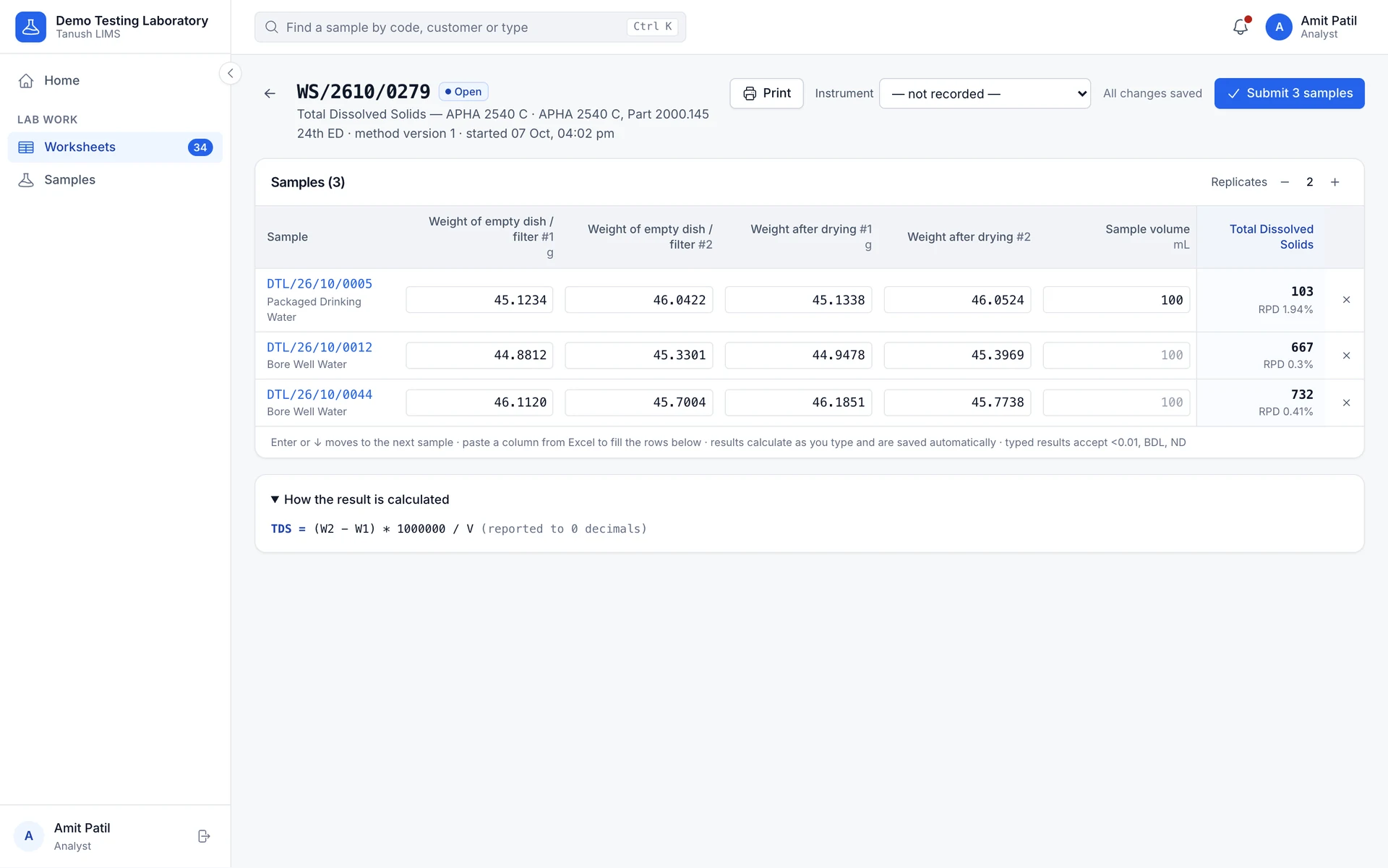
The analyst types the readings of the method: titre, weights, absorbance, plate counts. The result calculates on the spot, with duplicates compared. 477 of the 602 methods in the library already calculate. Prefer to type final results? Manual entry is one switch away.

Tanush LIMS worksheet calculating total dissolved solids from weights for three samples
89 Indian standards, 2,963 limits

Limits checked for you

IS 10500, CPCB Schedule VI, NAAQS, FSSAI and more, with the Indian rules built in: acceptable and permissible limits, discharge points, area categories, FSSAI m and M. Check each standard once and switch it on; from then on, results outside a limit are flagged before approval and marked on the report.

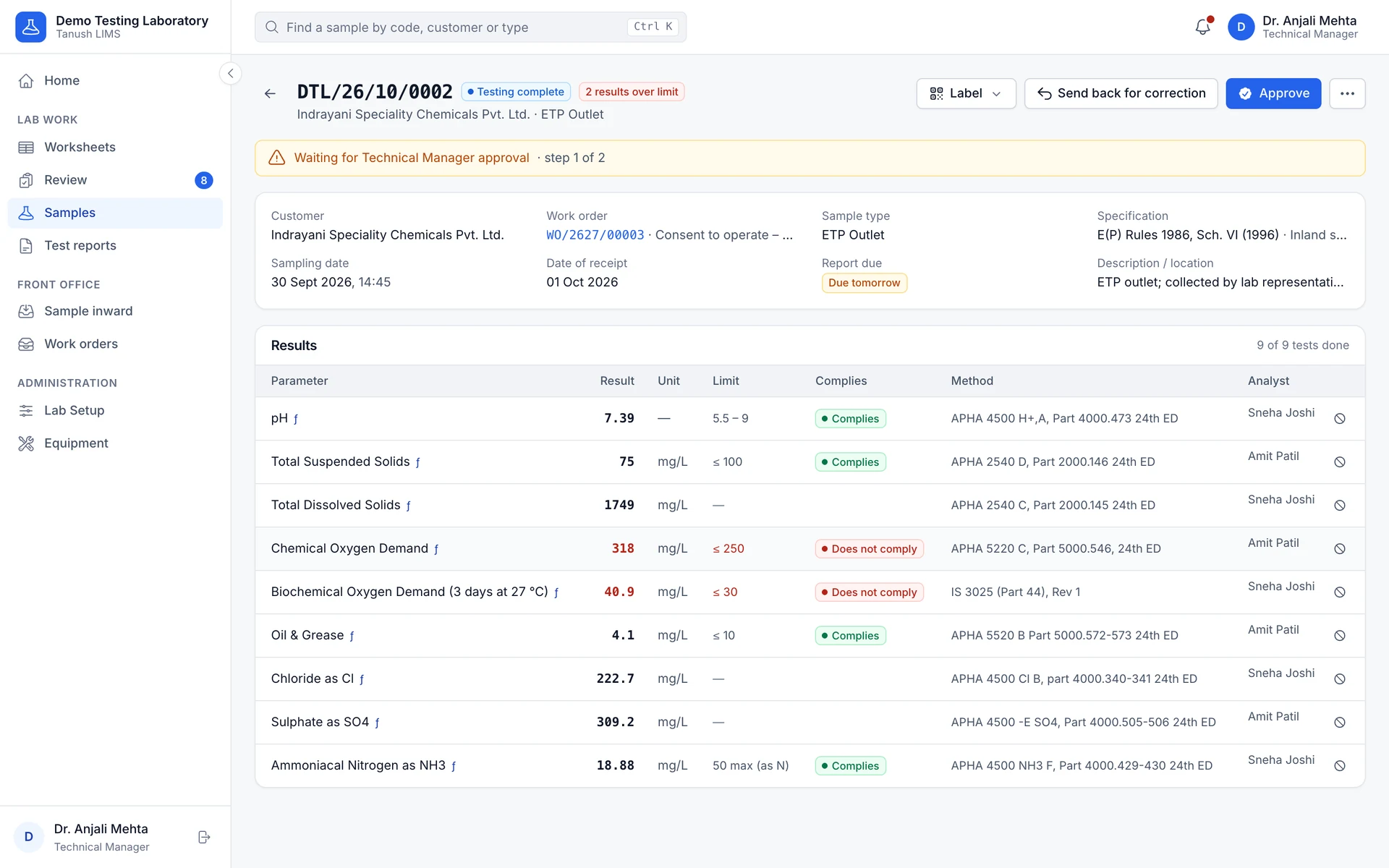
Tanush LIMS review screen for an ETP outlet sample: each result beside its E(P) Rules Schedule VI limit, with COD and BOD marked Does not comply

Your method, your formula

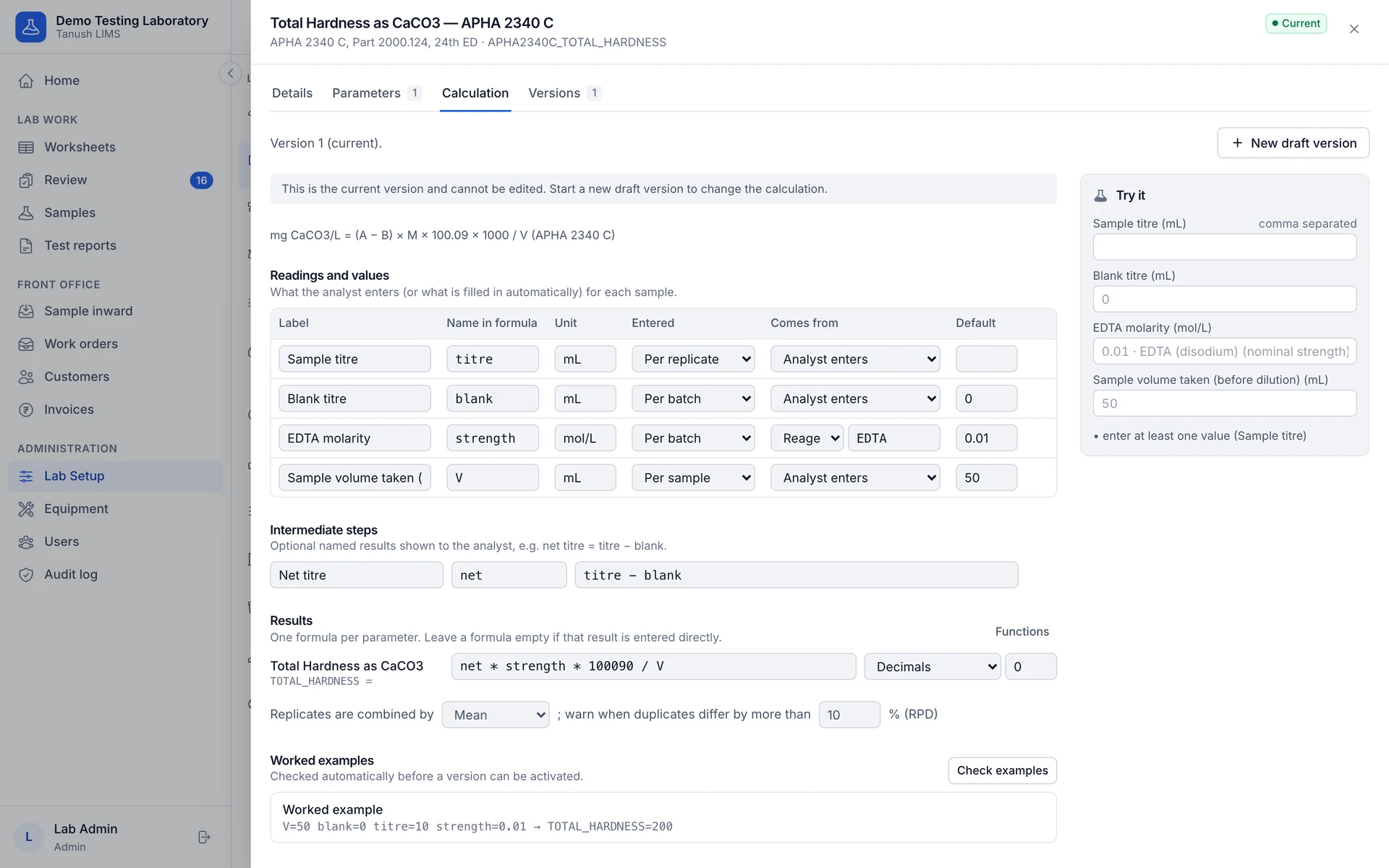
Use the method as your lab runs it, calibration curves included. Each formula is checked against worked examples before it can go live, and a change makes a new version that never alters past results.

Tanush LIMS formula editor for total hardness, with the readings, their units and a worked example that is checked before the method goes live

Specifications ready, versions kept

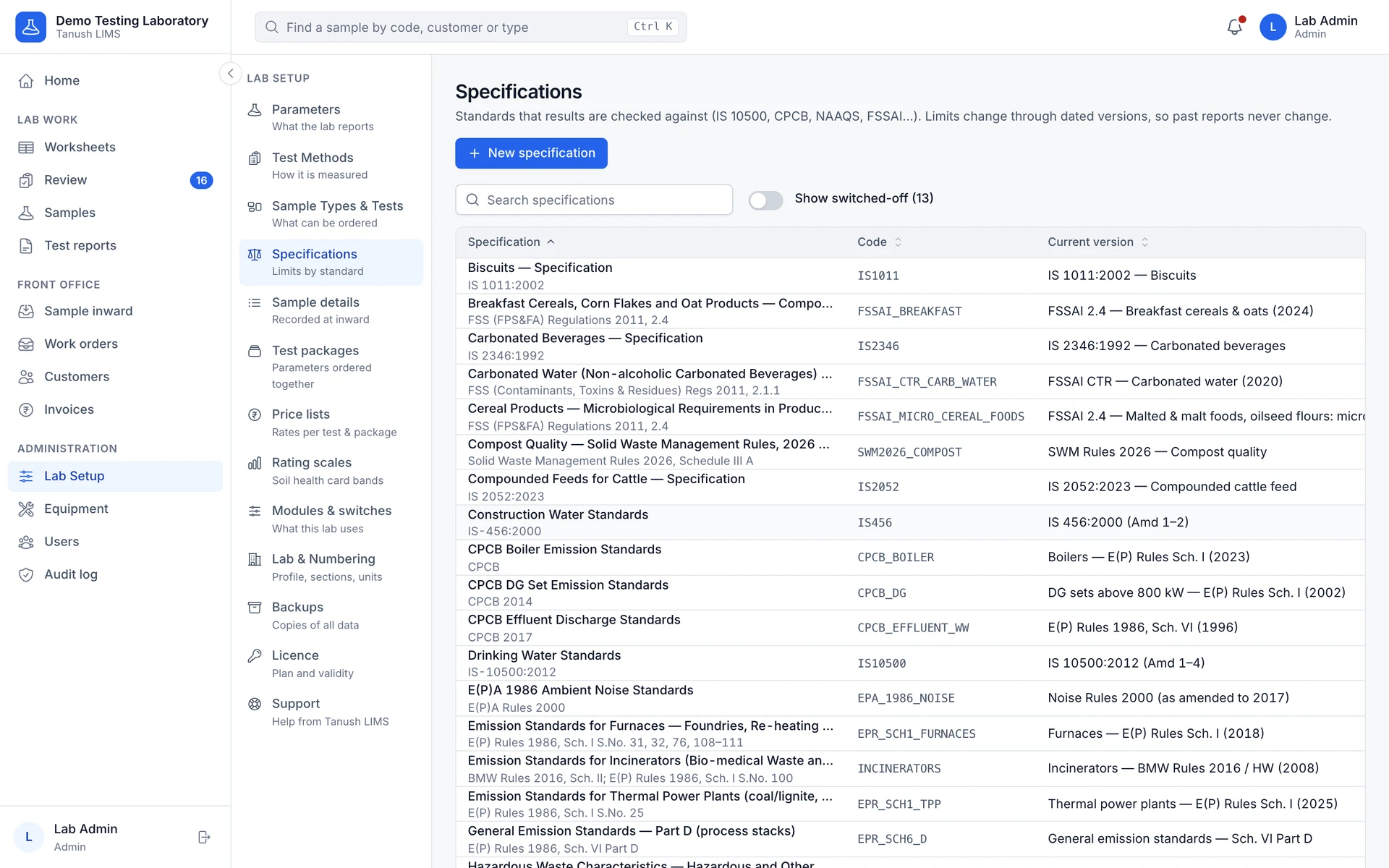
Standards come with dated versions, so past reports never change. A customer's own consent limits can be added and offered only for that customer.

Tanush LIMS specifications list with IS 10500, FSSAI, CPCB effluent, boiler, DG set and noise standards, each with its current dated version

NABL-format reports

ULR number, NABL symbol, parameters outside your scope on a separate report, method references and signatures, once your NABL number and scope are set.

Holding times and short samples

Time-bound tests show a start-by time from inward onwards, and Home lists the ones to start first. Late starts print ‡; tests done on less sample, with the customer's consent, print ◊.

Blind analysis, on by default

Analysts see the sample code and their own tests, never the customer or the report, so no result can be coloured by who the customer is.

Overdue instruments greyed out

The equipment register keeps each instrument's calibration and maintenance history and flags anything overdue. On the worksheet, an overdue instrument is greyed out, so results can't be recorded against it.

Amendments done properly

An amended report keeps its number and states its revision and reason. A withdrawn report is marked WITHDRAWN wherever it is opened or verified.

Front office and billing

Customers with sites and sampling points, test packages, price lists, GST invoices made from approved samples, and payments tracked down to TDS.

From sample receipt to issued report, in one LIMS.

Each step is done by the person responsible for it, and the status shows the same name on every screen. Pick a step to see its screen.

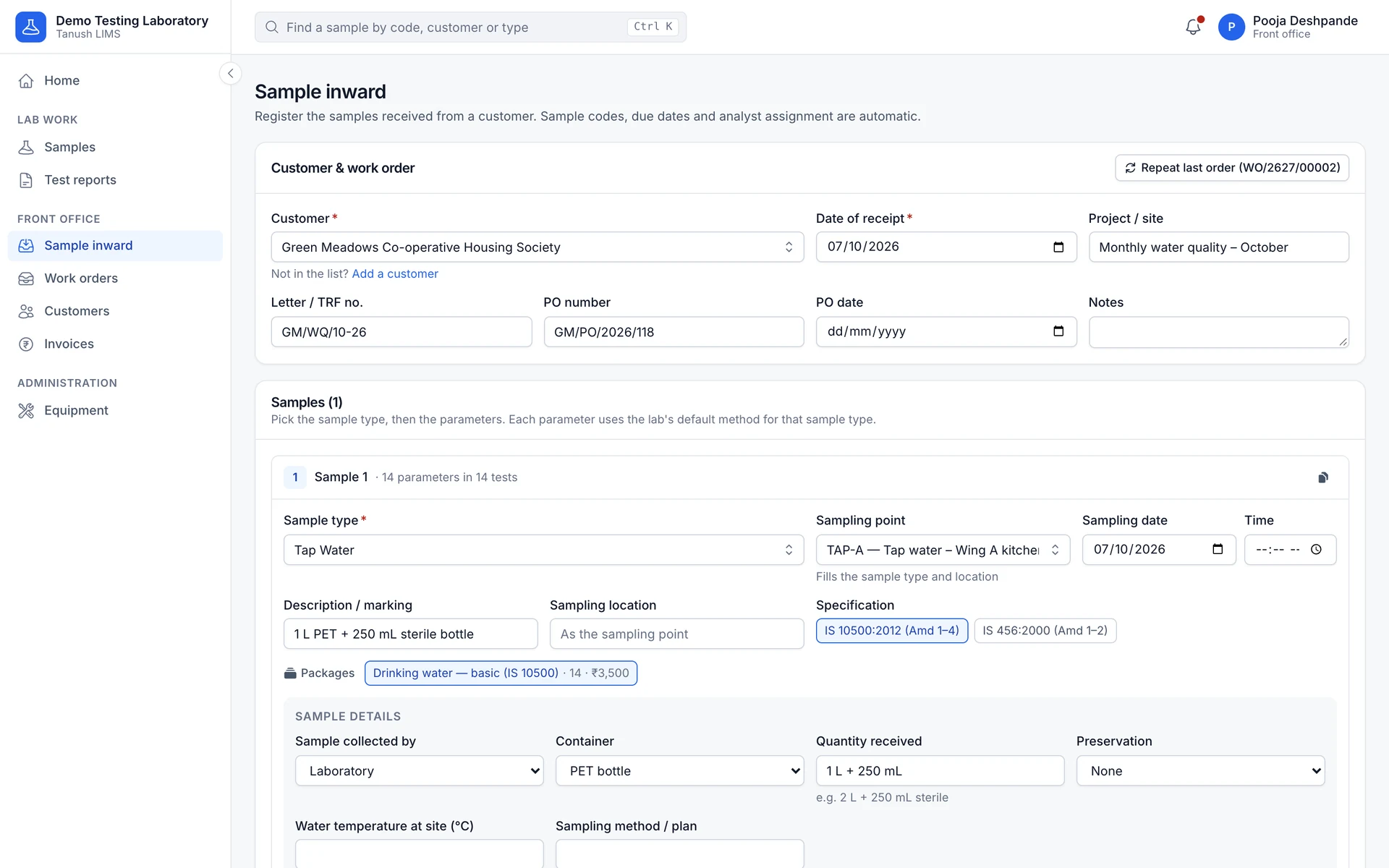
Tanush LIMS sample inward screen, from a demonstration lab

1. Sample inward, done by the front office. Customer, sampling point, specification, parameters and bottles on one screen. Sample codes and due dates are set automatically, barcode labels print, and the software suggests a chemist for each test.

Status after this step Registered

Sent back? The reviewer chooses "Correct an entry" or "Re-analyse" and gives a reason. The test returns to the analyst, and every earlier run stays on record. Once the Technical Manager approves, results are locked.

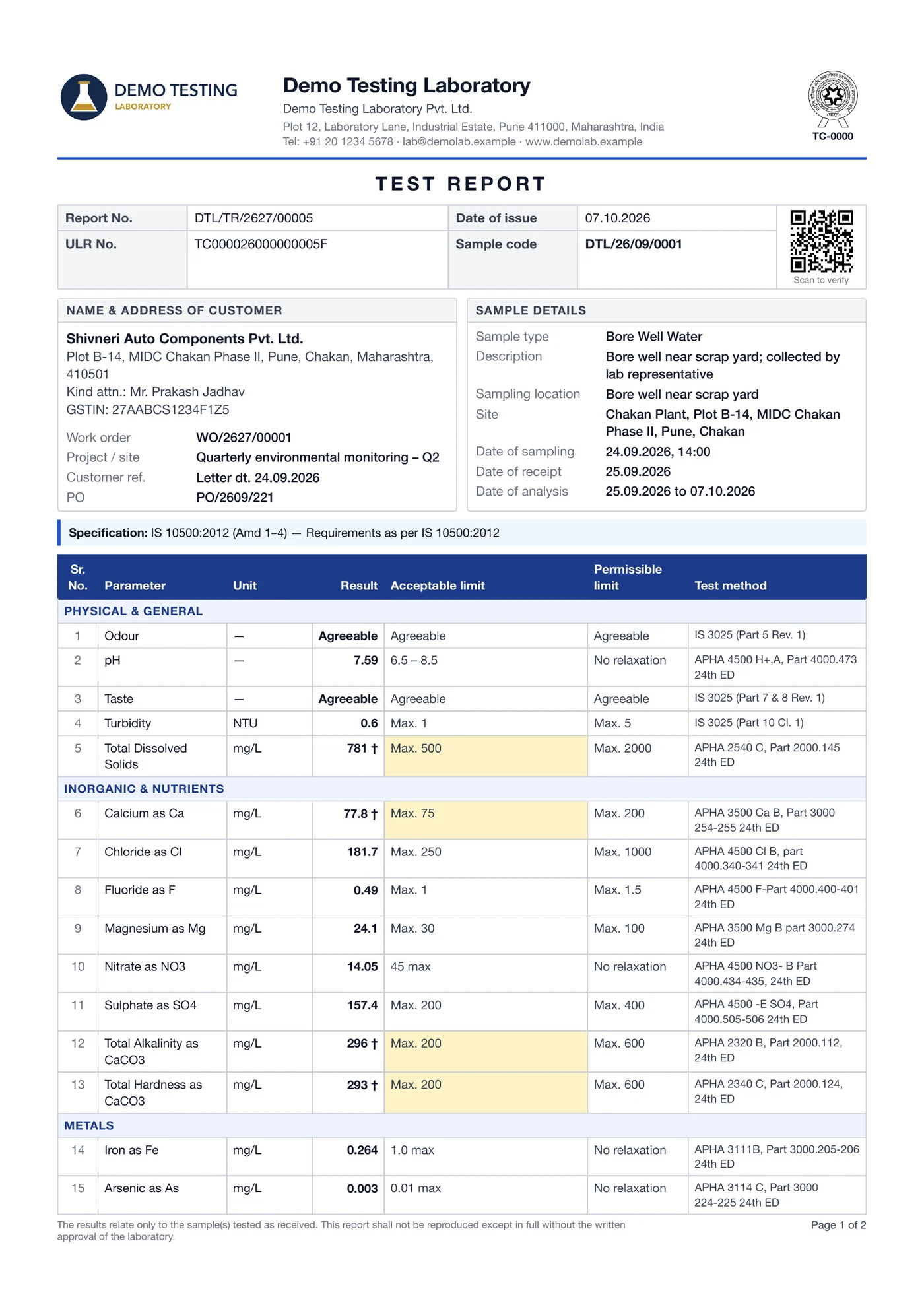
Page 1 of a Tanush LIMS bore well water test report from a demonstration lab, with the NABL symbol, ULR number, verification QR code, IS 10500 acceptable and permissible limits and method references 1 2 3 4 5 6 7

Specimen report from a fictional lab.

What your customer receives: a NABL-format test report.

Page 1 of a drinking-water report, made from the approved results with nothing typed again.

  1. ULR numberBuilt from your NABL certificate number.
  2. NABL symbolWith your accreditation number, once your scope is set. Parameters outside the scope can go on a separate report with its own number.
  3. Verification QRCustomers scan it to see that the report is genuine and current, and can check that their PDF copy hasn't been changed. It prints once your verification page is online.
  4. SpecificationThe standard and version the results were checked against.
  5. Both limitsAcceptable and permissible limits side by side.
  6. Marked resultsA dagger above the acceptable limit, an asterisk outside the limit.
  7. Method referenceFor every parameter, fixed when the test was ordered.

The last page carries each approver's name, designation, signature and date of approval, taken from the review itself. Other layouts cover stack emission, noise and soil health cards, plus one combined report for a whole project.

Indian standards built in, then set to your NABL scope.

Every lab gets the same library. We set it to your NABL scope, your methods and your limits: your scope sheet is imported from Excel, with a preview of every row before anything is saved. Updates never change your scope.

602test methods in the built-in library
477methods that calculate from readings
552parameters across 14 sample groups
89Indian standards with 2,963 limits
6user roles, front office to signatory
4report layouts, plus combined project reports

Works without internet

Installed on one Windows PC in your lab; every other PC opens it in a browser. Internet is only for optional extras.

Safe through power cuts

Unsaved readings and inward entries stay on that PC and come back with one click. A wrong date on the server PC stops new entries until it is fixed.

Backups on their own

Every 3 hours and before every update, with a second copy on a USB drive or second disk. An encrypted cloud copy is optional.

Updates that undo themselves

We install signed updates for you. A backup is taken first, and if anything fails, the old version and your data come back by themselves.

Three steps to go live.

  1. Demo

    20 minutes, online, with your report format. Send us one of your current reports before the call.

  2. Setup

    We install it on your PC, import your NABL scope and methods, switch on the standards you use, and set up your logo, signatures and numbering.

  3. Go live

    Hands-on training for front office, analysts and reviewers, and support after.

Questions testing labs ask first.

Does it need internet?

No. Tanush LIMS is installed on one Windows PC in your lab, and every other PC opens it in a browser over the lab network. Internet is needed only for optional extras: remote support, the encrypted cloud backup copy and the page customers open from the report QR.

Are the reports in NABL format?

Yes, once your NABL number and scope are set: ULR number, NABL symbol with your accreditation number, parameters outside your scope on a separate report, method references and signatures. Accreditation itself is granted to your lab, not to software. Labs without accreditation get the same reports without the NABL symbol and ULR.

Can we keep our own numbering?

Yes. Sample, report and invoice numbers follow your own pattern and can carry on from your old software's last number. Reports carry your logo, signatures and NABL scope.

Do analysts have to work with formulas?

No. Each lab chooses: analysts enter readings and the LIMS calculates the result, or they type the final result as they do in a register today. You can change this later.

Which labs is it for?

Testing labs: water and wastewater, food, soil, compost and sludge, ambient and indoor air, stack, noise and lux, fuels, water treatment chemicals, construction materials, and EIA monitoring. It is not built for pathology or diagnostic labs.

Does it track our instrument calibration?

Yes, for your own instruments. The equipment register keeps each one's calibration and maintenance history with due dates and flags anything overdue or due soon. When an analyst records the instrument on a worksheet, an overdue one is greyed out and results can't be recorded against it. Labs that calibrate instruments for clients (calibration certificates with measurement uncertainty) are not covered.

Can results come from our instruments?

Readings from AAS, ICP and flame photometers can be imported from their CSV or Excel export files: each row is matched to its sample, blanks and standards are skipped, and you check every reading before it is filled. There is no direct cable connection to instruments; other readings are typed.

What happens in a power cut?

Unsaved readings and inward entries stay on that PC and are offered back with one click when you return. Backups run every 3 hours and before every update, with a second copy on a USB drive or second disk.

How is it licensed and supported?

As a subscription or a one-time licence. The licence is checked on your own PC with no internet, and your data always stays viewable and printable. Setup, training and support come straight from Tanush Digital, the maker, with no reseller in between.

Is Tanush LIMS NABL approved?

NABL accredits laboratories, not software. Tanush LIMS is built for accredited labs: ULR numbers, parameters outside the scope kept off the accredited report, blind analysis, holding-time and short-sample marks, and amendments and withdrawals worded the way ISO/IEC 17025 expects.

See a sample go from inward to issued report.

Book a 20-minute demo. Send us one of your current report formats first, and we will walk you through it on the call. We reply within 24 hours.

We use your details only to contact you about this enquiry.